System infographic
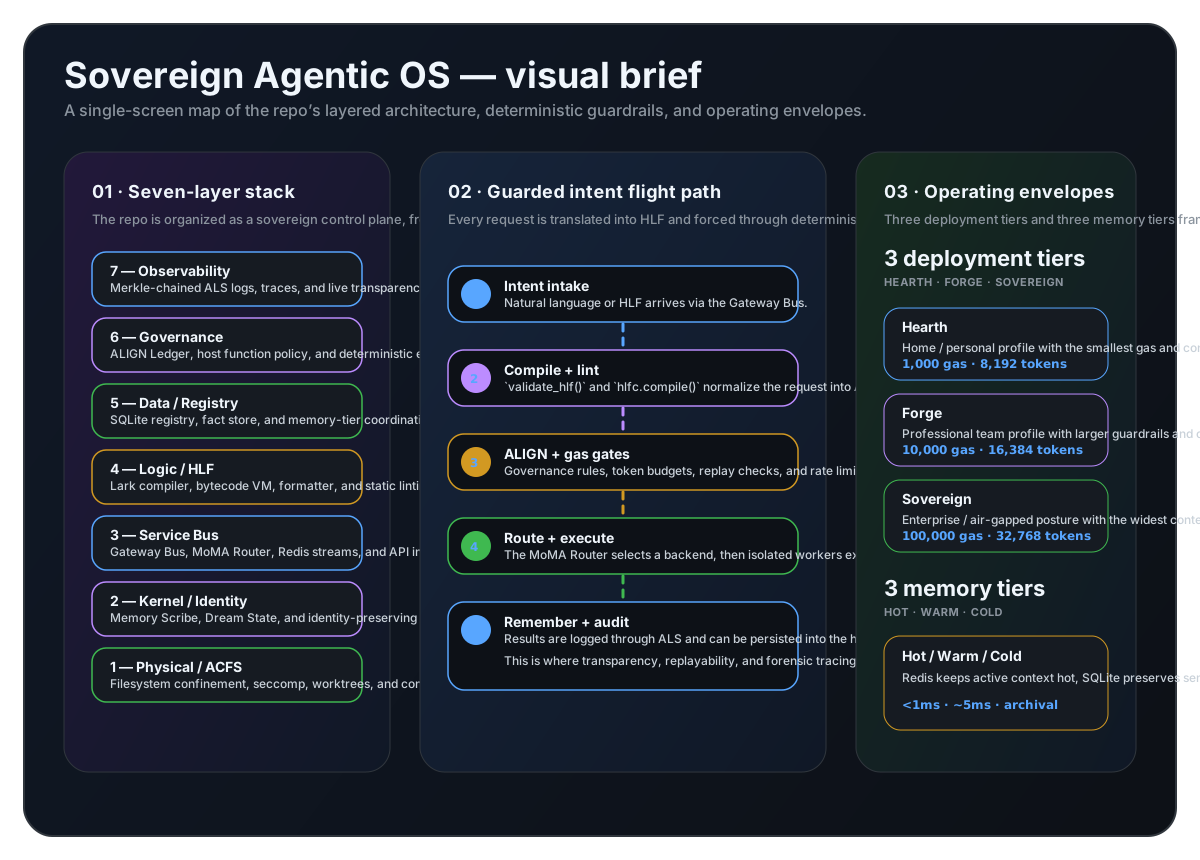
A single-screen briefing for the repo’s layered architecture: ACFS confinement at the base, HLF logic and governance in the middle, and observability plus memory on the upper tiers.
Open source SVG →Watch natural language transform into deterministic hieroglyphic instructions, get processed by agents, and translate back — with live metrics.
This visual layer distills the full repository scan into an at-a-glance briefing: what the major layers are, how an intent moves through them, and where governance, memory, and runtime boundaries show up in the stack.
A single-screen briefing for the repo’s layered architecture: ACFS confinement at the base, HLF logic and governance in the middle, and observability plus memory on the upper tiers.
Open source SVG →Four slide-style summaries map the major discovery passes: overview, architecture, flow analysis, and deep-dive surfaces that are easy to miss on a first read.
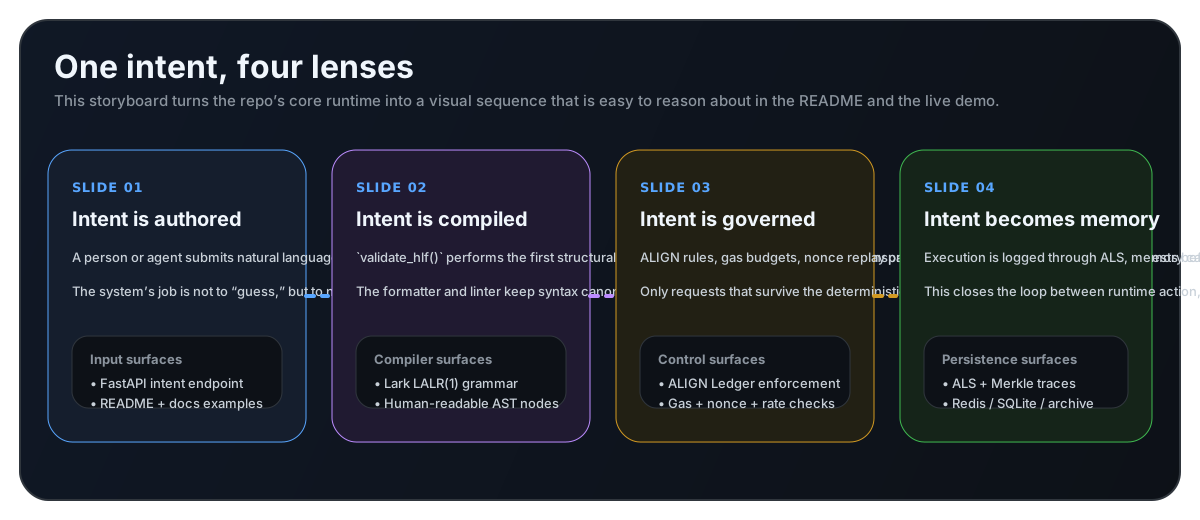
A cinematic strip for the live demo: authored intent, compiler pass, governance envelope, then audit + memory persistence. It turns the stack’s control flow into something a reader can absorb in seconds.
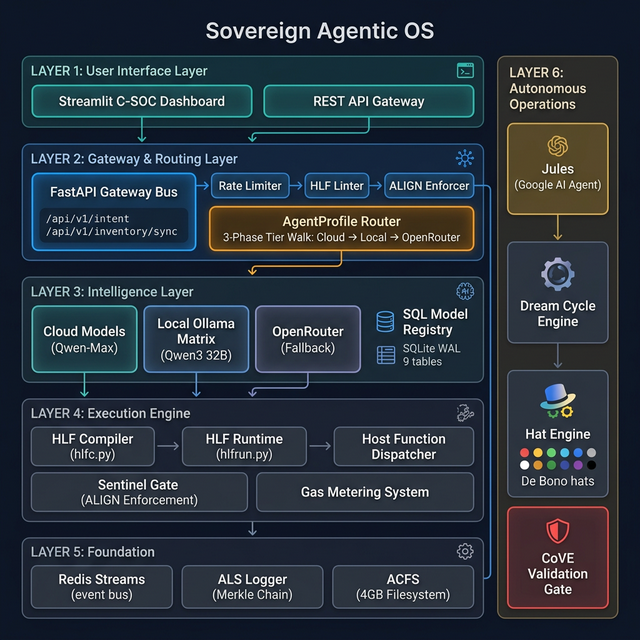
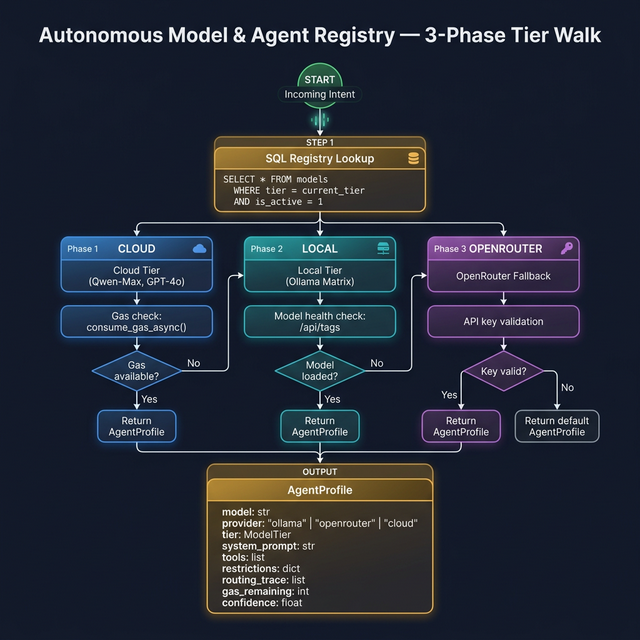
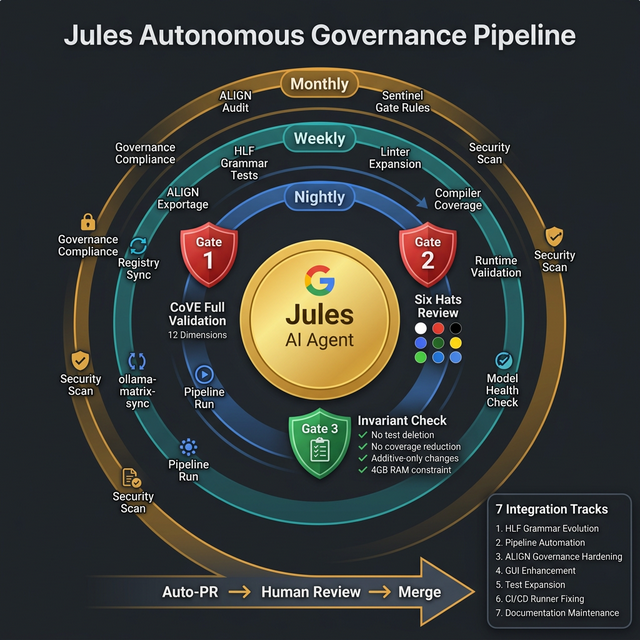
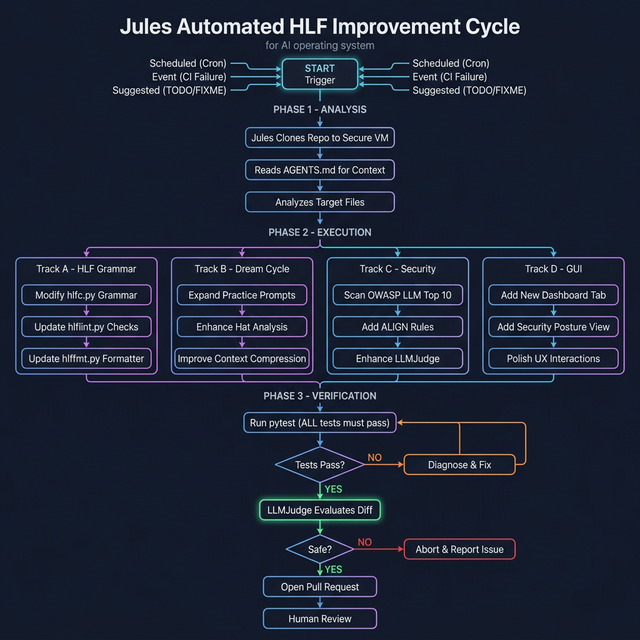
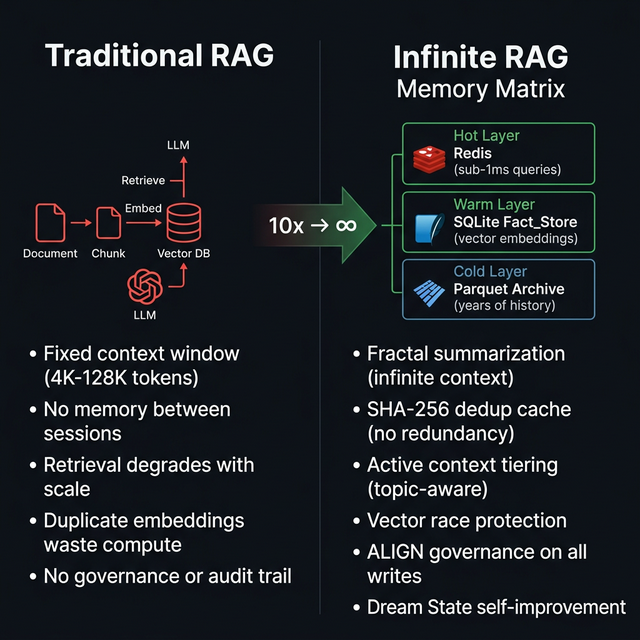
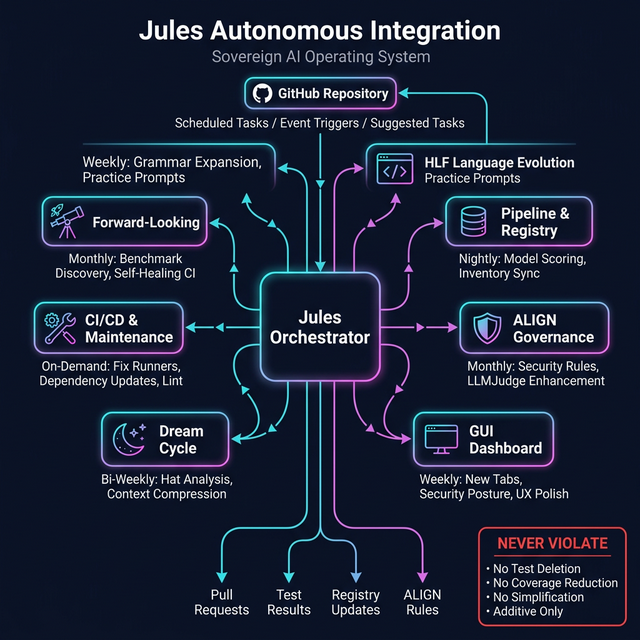
Open source SVG →I reviewed the older media set and brought back the pieces that still do the most work for readers: architecture, routing, governance, Jules orchestration, and the Infinite RAG comparison.
This live demo limits translations to 5 per day to conserve shared resources. Fork the repo and deploy your own instance for unlimited translations, your own Jules agent swarm, and the ability to contribute HLF grammar evolutions back to the canonical spec.
Each fork running its own agent swarm contributes to exponential language improvement. Your agents propose grammar evolutions (RFC 9006), which get validated and merged upstream, making HLF better for everyone — for programming, product creation, and multi-agent orchestration.
gh repo fork Grumpified-OGGVCT/Sovereign_Agentic_OS_with_HLF --clone
cd Sovereign_Agentic_OS_with_HLF
uv sync
Copy the template and fill in your credentials:
cp .env.example .env
Required keys in your .env file:
REDIS_PASSWORD — Redis auth (for gateway message bus)OPENROUTER_API_KEY — Cloud model access (Sovereign tier)GITHUB_TOKEN — For Copilot factory / agent dispatchOptional but recommended:
OLLAMA_HOST — Primary Ollama endpoint (default: http://localhost:11434)OLLAMA_HOST_SECONDARY — Secondary Ollama at :11435 (doubles cloud quota)OLLAMA_LOAD_STRATEGY — failover | round_robin | primary_onlySLACK_WEBHOOK_URL — Agent alert notificationsSTREAMLIT_SECRET_KEY — GUI session encryption⚠️ Never commit your .env file — it's already gitignored with 70+ rules.
Save all keys in .env at the project root. The system auto-loads them via python-dotenv.
Jules is your autonomous maintenance & evolution agent. To set up your own upgraded swarm:
config/jules_tasks.yamlWith your own swarm, you get:
# Enable GitHub Pages (Settings → Pages → Source: GitHub Actions → Static HTML)
# Set path to ./docs
# Your translations are now unlimited — no quota on self-hosted forks!
# List available agent task templates
python scripts/copilot_factory.py list-templates

# Dispatch an HLF test agent (dry run first)
python scripts/copilot_factory.py hlf-test --dry-run

# Create a live Copilot agent issue
python scripts/copilot_factory.py hlf-evolve
Read the full HLF specification and architecture docs in the repo:
source_knowlwedge/HLF_The_Hieroglyphic_Logic_Framework_for_Agentic_Orchestration.mdsource_knowlwedge/RFC_9005_The_HLF_Native_Language_Specification_v3.0.mdsource_knowlwedge/The_HLF_v3.0_Protocol_Transparent_Compression_in_Systems_Programming.mdbuild_notes/HLF_Core_A_Sovereign_Architecture_for_Secure_Agentic_OS.mdAGENTS.md — Security invariants and test conventionsThe Sovereign OS uses a 3-tier memory architecture that eliminates the context window ceiling found in traditional RAG systems.
query_memory() tool wired| Dimension | Traditional RAG | Infinite RAG |
|---|---|---|
| Context Limit | 4K–128K tokens (hard ceiling) | Unlimited — fractal compression |
| Memory | Stateless per session | Persistent — fact_store survives reboots |
| Retrieval Speed | 10-100ms (vector search) | <1ms — Redis hot cache pre-loads topics |
| Deduplication | None (embed same text repeatedly) | SHA-256 cache eliminates redundant embeds |
| Self-Improvement | Static — needs human re-indexing | Dream State — nightly auto-compression & rule synthesis |
| Governance | No write controls | ALIGN Ledger enforces all memory writes |
Traditional: Ask a question, get a one-off answer. No continuity.
Infinite RAG: Agent remembers your preferences, past decisions, project context across sessions. "Remember that DB config we set up last month?" → instant recall.
Traditional: Re-explain architecture every session. Loses context mid-refactor.
Infinite RAG: Knows your entire codebase topology. Dream State synthesizes daily learnings into rules. Multi-agent swarm shares persistent facts, not tokens.
Traditional: Can't handle month-long research projects or adversarial testing.
Infinite RAG: Cold Parquet archive spans years. Cybernetic auto-immune system uses honeypot logs as negative training. Agent evolves its own governance rules.
HLF and the Infinite RAG are designed to amplify each other:
| Without HLF | With HLF |
|---|---|
| RAG ingests verbose NLP → bloated fact_store | RAG ingests compressed HLF ASTs → smaller, denser embeddings |
| Context fills fast → frequent summarization | HLF intents 12–30% smaller → more facts per prompt |
| Cross-agent shares prose → ambiguous retrieval | Agents share typed HLF → exact semantic matching |
| Dream State compresses NLP → lossy | Compresses HLF → lossless (AST round-trips) |
| No governance on memory writes | Every write through ALIGN Ledger |
⚡ Compound effect: HLF compression means the Infinite RAG stores more knowledge per byte, retrieves faster (smaller vectors = faster cosine), and shares more precisely across the swarm.
Where this goes:
Architecture from §3.2 of the Master Build Plan